
How architects write a site observation report
Updated September 3, 2026
Fill this in on your iPhone, on site, with Sitewise.
Get the appThe architect's site observation report gets read twice: once by the client this week, and once by somebody's lawyer three years from now. Write for the second reader and the first one gets a better document anyway.
Most of what makes a report defensible is decided on site, in the ten seconds after the photo. Where you were standing. What you were looking at. Whether the sub had already been told about it on the last visit. None of that comes back to you in the car.
The word observation is carrying legal weight
Architects write observation and not inspection on purpose. Inspection implies you checked the work against a standard and passed it. Observation says you were there, you looked, and you are reporting what you saw. The distinction runs through owner-architect agreements, and it is why a careful report describes conditions instead of handing down verdicts.
In practice that means writing "grout at the north stair landing is cracked along roughly 24 inches and the crack crosses three tiles" rather than "tile work is defective and must be replaced." The first is an observation. The second is a determination, and determinations belong in a different document with a different signature on it.
The same rule covers means and methods. You can record that the shoring at grid C looked different from the shop drawing you were sent. Telling the contractor how to shore it is not your job, and it moves risk onto your side of the line.
Five parts, and the rest is padding
A site observation report needs a header block, numbered observations, a status on each one, the items carried over from last time, and a distribution list.
The header block holds project name and number, date, arrival and departure times, weather when it bears on the work, who was on site and for which trade, the visit number, and the stage of construction. Arrival and departure times read as bureaucracy right up until the week somebody asks whether you were on site when the slab went in.
Observations are numbered, one condition each: a photo, a location precise enough to find again (grid line, room number, floor, elevation), what you saw, and what it relates to in the contract documents.
Status is one word per item, and three words cover nearly everything. Information means it is in the record and nobody has to act. Review means somebody has to look and come back. Action means the item is open against a named party with a date on it.
Carried-over items are the part everyone skips. An observation that first appeared on visit 4 and is still open on visit 9 is a different fact from one that appeared today, and only the carry-over section shows the difference.
Numbering survives the project, renumbering ruins it
Number observations continuously across the whole job, not per visit. Observation 47 stays observation 47 forever, on every report that mentions it and in every email about it. Per-visit numbering means "item 3" refers to eleven different things by the end of the job, and correspondence stops being searchable.
A closed item does not get deleted. It gets a closing note and a date on the report where it closed. The record of what closed and when is what you will want on a job that goes sideways.
A photo without a location is half a record
Photograph the condition, then photograph the context. A tight shot proves a crack exists. A wide shot from ten feet back proves it is the crack at the north stair landing and not one of four similar cracks elsewhere in the building.
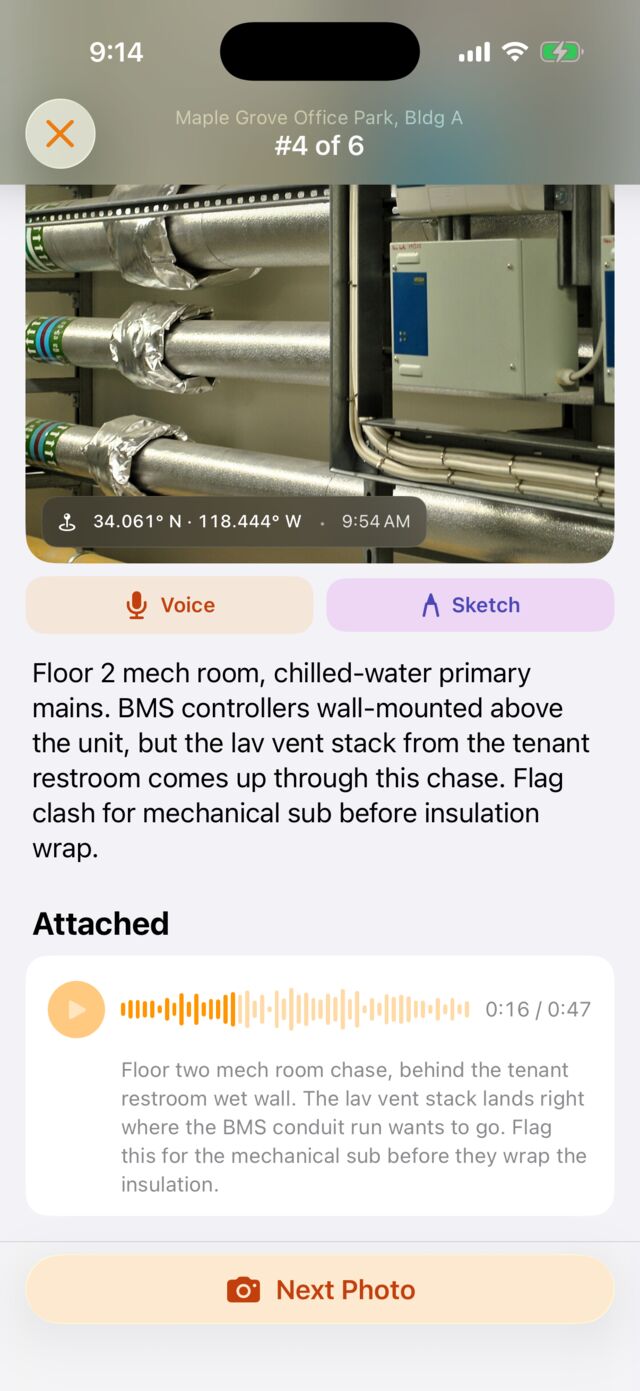
Timestamps and coordinates are the part you cannot reconstruct later. A camera roll gives you the time. A phone with location on gives you the pin. Neither helps if the photos sit in the camera roll while the notes sit in a notebook, because pairing them up at the office is where the time goes and where mistakes get made.
The report is finished when you leave, or it is finished at nine at night
Every hour between the visit and the write-up costs accuracy. Details you did not record get smoothed over. Two similar conditions merge into one. The foreman's explanation for why the duct sits where it does turns into your explanation.
Sitewise is built for that gap. You photograph the condition, hold the button and say what you are looking at, and the voice note transcribes on the iPhone itself. If the photo needs an arrow or a circle, you draw on it. Each capture carries its time and, with location on, a GPS pin. When the walk is done, the project exports as a PDF or a DOCX and you email it from the parking lot. It works with no signal and syncs once the phone finds one, which matters in a basement or a lift shaft.
Be clear about what it will not do for you. Sitewise has no scheduling, no budgeting, no CAD or drafting, and no e-signature workflow. It runs on iPhone and iPad on iOS 26 or later, with no Android app and no web version. It is free during the launch period, and carries no ads and no tracking. If the report has to route for signature or live inside a drawing set, you need something else alongside it.
Say what you saw, then stop
Three habits separate a report that helps from one that creates work.
Write in the past tense about conditions, not the future tense about intentions. "Sprinkler drops at the corridor ceiling were not installed at the time of the visit" is a fact. "Sprinkler drops will be installed next week" is a promise made on someone else's behalf.
Quantify. A crack has a length. A gap has a width. A missing item has a count. "Several outlets" is worth less on every reading than "four outlets on the east wall of Suite 203".
Note who was told. If you walked the condition with the mechanical foreman and he saw it, the report says so. Verbal notice that appears nowhere in writing is verbal notice that did not happen.
For the structure as a fill-in document, the site visit report template lays out the header block and observation fields, and how to write a site visit report covers the same ground for smaller jobs without a construction administration contract behind them.
The test is whether visit 9 can explain visit 4
A good run of observation reports lets somebody who was never on the job reconstruct what the building looked like on a given Tuesday, who knew about it, and what happened next. That is easy to describe and hard to do, and it gets done on site one numbered photo at a time rather than at a desk at nine at night.
Questions people ask
- Is a site observation report the same as an inspection report?
- No. An inspection report says the work was checked against a standard and passed or failed. An observation report says the architect was on site, looked, and recorded conditions. Owner-architect agreements are commonly written around observation for exactly that reason, so the language in your report should match the agreement you signed.
- How soon after a site visit should the report go out?
- Same day is the standard worth holding yourself to, and before you leave the site is better. Accuracy drops with every hour between the walk and the write-up, and an observation dated three days after the visit is easier for another party to argue with than one dated the afternoon it happened.
- Do the photos have to sit inside the report, or can they be a separate album?
- Inside. A photo in a separate album gets separated from its caption, its location and its date the first time somebody forwards the file. Numbered observations that carry the photo, the note and the timestamp in one document stay readable years later, which is the reason to keep them at all.
Related guides
- How to write a site visit report
Write the site visit report on site, not at 9pm. How to capture in walk order, caption in measurements, cut the photo set and send before you leave.
- Site visit report template
A site visit report template with the header fields, numbered observations and caption pattern that hold up in a dispute, plus a filled example and sample PDF.
Write this report on site, not in the truck.
Sitewise turns photos, voice notes, sketches, and typed observations into a PDF or DOCX before you leave. iPhone and iPad, iOS 26 or later.
Get the app