
How to write a site visit report
Updated October 15, 2026
Fill this in on your iPhone, on site, with Sitewise.
Get the appThe site visit report is written on site or it is written badly. That is the whole argument, and everything below follows from it.
The alternative is what most people actually do: walk the building, take forty photos, drive back, then open the laptop at nine that night and try to remember whether the water stain was in room 214 or 216. Six hours of gap between seeing a thing and describing it. The detail that made the observation worth reporting is the first thing to go.
Decide who is reading before you take the first photo
A report to an owner, a report to a general contractor and a report to a lawyer are three different documents built from the same walk.
The owner wants to know what it costs them and what happens next. The GC wants the room number and the sub's name. The one that might be read in a dispute wants dates, measurements and no adjectives. You cannot serve all three at once, and trying produces the report nobody reads.
Pick one primary reader. Address the report to a person, not a distribution list, and copy the rest.
Capture in the order you walk
Start at the point of entry and move through the building in a route you could repeat. Main service room, then level 2 corridor, then the mech room, then the roof. Do not double back to grab a shot you missed, and do not group photos by trade as you go.
Walk order gives the report a structure you did not have to write. A reader who was not there follows your route through the building instead of reading a shuffled pile of images, and when someone asks whether you looked at the north stair, the sequence answers it.
Number the observations in that same order and leave the numbers alone afterwards. Renumbering by severity feels tidy and breaks every reference: the RFI that cites #17, the sub's email about #17, your own follow-up walk.
Say it out loud, then fix the transcript
Typing a three-sentence observation on a phone while holding a flashlight is the reason most captions end up as "crack in wall".
Dictating is faster and it produces more: what the thing is, where it is, why it matters, who needs to do something. A spoken note runs long and rambles a little, and that is fine, because you are going to trim it before the report goes out. What you cannot recover later is the detail you never said.
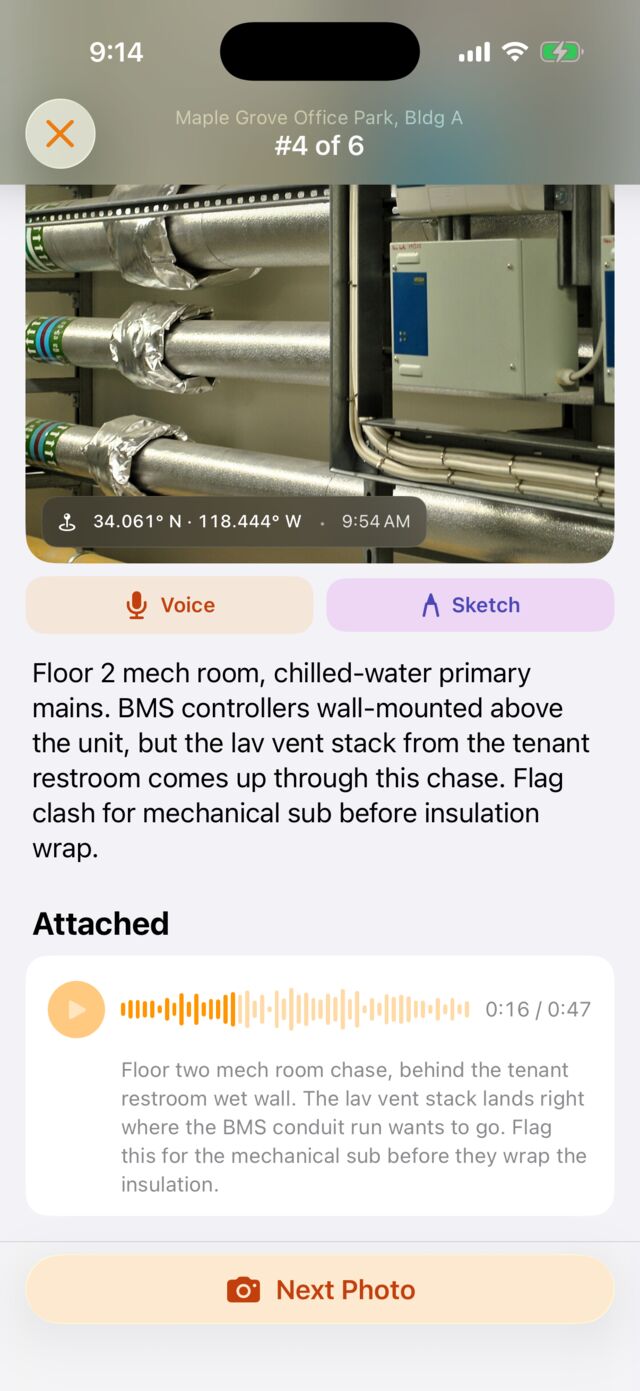
Read the transcript once before you move on. Dictation mangles proper nouns and unit numbers, and "Suite 203" comes back wrong often enough to be worth checking every time. A wrong room number in a report is worse than no room number.
Write in measurements, not impressions
Compare two captions on the same photo.
"Clearance at the rear of the switchgear appears tight."
"Rear-cell working depth measures 28 inches against the structural beam. Spec calls for 30."
The first one starts a conversation. The second one ends it, and the only difference between them is that somebody pulled out a tape measure.
The pattern that holds up: location, then what is there, then what is wrong with it in numbers, then what you want done and by whom. Four clauses, usually under forty words.
| Clause | Weak | Strong |
|---|---|---|
| Location | Second floor | Mech room 204, above the door |
| What is there | Some pipes | Chilled-water primary mains and the BMS conduit run |
| What is wrong | Looks like a conflict | Lav vent stack rises through the same chase at the controller elevation |
| Action | Needs review | Mechanical sub to confirm reroute before insulation wrap |
Hedge where you genuinely do not know, and hedge precisely. "No active drip at 10:40" is a fact with a time on it. "Appears to be a possible leak" is a sentence written by someone protecting themselves, and every reader can tell.
Cut the photo set before you send it
A 40-photo walk is not a 40-photo report. Some frames are context you took to orient yourself, some are the same fixture from three angles, some came out dark.
Choose the ones that carry a finding. Keep one wide shot per area so the reader can place the close-ups. Everything else stays in the project, where it is still available if someone asks in March what the ceiling looked like in June.
The rule that decides most of them: if you cannot write a caption for a photo, it does not go in the report.
Put the findings on the front page and the photos after
A reader decides in the first page whether the report needs anything from them. Make that page the answer: the project, the date, who was there, who the report is for, and the observations that need action, each as one line with its number. Anything that needs a decision goes at the top of that list.
The photos follow, in walk order, with the caption directly under each one. One or two photos to a page is enough for a reader to see the defect without zooming. Six thumbnails to a page looks thorough and shows nothing.
Keep the number on the photo the same as the number on the front page. A reader who sees "#6, water staining below the level 3 restroom" on page one should be able to find #6 in the photo pages without reading the rest.
Send it from the site, not from the office
The report that arrives while the GC is still on the job gets treated differently from the one that arrives Thursday. People are still in the building. The sub is still on the roof. Item #6 gets looked at that afternoon instead of at the next coordination meeting.
Timestamps and GPS on each capture handle the rest. When a report is written from the field, its metadata says so, and nobody has to take your word for the visit date.
Sitewise is built around that sequence: photo, dictated note transcribed on the phone, sketch on the image, typed observation, each capture stamped with time and location, all of it working with no signal because service rooms rarely have any. When the walk is done, the project exports as a PDF or DOCX you can email before you reach the car. It runs on iPhone and iPad, and it does not schedule work, track budgets, draw plans or collect signatures.
For the structure the finished document should follow, the field list and a filled-in example are in the site visit report template.
One habit does more for report quality than any template: after you write a caption, look up and check that the photo shows what the caption says. It catches the corrections you would otherwise be making at nine at night.
Questions people ask
- When should you write a site visit report?
- While you are on site, one observation at a time, as you take each photo. The gap between seeing something and describing it is where the detail goes. If you write the whole report that evening you are working from forty photos and a memory of which room was which, which is how "cracking at the north wall" ends up attached to a photo of the south wall.
- How do you write a site visit report if you are not sure what caused a problem?
- Describe what you can see and measure, then say plainly what you would need to know more. "Staining across three ceiling tiles below the level 3 restroom wet wall; no active drip at 10:40" is defensible. "Roof leak" is a guess, and if the plumbing above turns out to be the source, the guess is what gets quoted back at you.
- Who should a site visit report be addressed to?
- One named recipient who can act on it, with everyone else copied. A report to a distribution list of nine people belongs to nobody. Naming the general contractor's project manager in the first line, then copying the owner and the design team, means someone specific is expected to answer the open items.
Related guides
- Site visit report template
A site visit report template with the header fields, numbered observations and caption pattern that hold up in a dispute, plus a filled example and sample PDF.
- Construction photo documentation that still makes sense in three years
How contractors shoot, caption and file job site photos so they hold up later: wide-medium-tight, pre-cover shots, scale objects and same-day captions.
Write this report on site, not in the truck.
Sitewise turns photos, voice notes, sketches, and typed observations into a PDF or DOCX before you leave. iPhone and iPad, iOS 26 or later.
Get the app