Quality control inspection report template for construction
Updated October 8, 2026
Fill this in on your iPhone, on site, with Sitewise.
Get the appA construction quality control inspection report records one inspection of one piece of work: what was checked, against which drawing and spec section, what was found, and whether the work can proceed. The template below keeps it to that. One report per inspection, each one tied to the work it covers, so that six months later someone can find the pre-pour check for Level 2, Pour 4 without reading a week of site diary.
The common failure is the opposite. QC observations get folded into the daily report or a running spreadsheet, and when a slab cracks or a wall leaks, nobody can say which inspection covered that bay, who did it, or what revision of the drawing they checked against.
One inspection, one report
A QC report answers a narrow question: was this work, in this location, built to these documents, at this time?
Keep the scope that tight and the report stays findable. A report scoped to "Level 1 slab, Pour 3, gridlines B to D, 2 to 5" can be filed against that pour and pulled up by anyone who asks about it. A report scoped to "Tuesday" cannot.
If a walk covers three activities, write three reports. It costs a few extra minutes on site and saves hours whenever one of those activities is questioned.
The header fields
Every report carries the same header. Fill all of it, every time, before the first check.
| Field | What goes in it |
|---|---|
| Report number | Sequential per project, never reused |
| Project | Name and number |
| Activity | The work inspected, in plain words: "slab on grade reinforcement" |
| Location | Level, area and gridlines, precise enough to walk to |
| Inspection type | Preparatory, initial, follow-up, hold point release, or final |
| Drawings | Sheet numbers with revision letters |
| Spec sections | The sections the work is checked against |
| Inspector | Name and role of the person who looked |
| Others present | Foreman, engineer, owner's rep, anyone who witnessed it |
| Date and time | When the inspection started and finished |
| Result | Accepted, accepted with conditions, or rejected |
The drawing revision is the field people skip and later regret. A rebar layout checked against revision B is not a check of revision C, and the report has to say which one was on the table.
Inspection type follows whatever system the contract uses. Federal work in the US often runs the three-phase control system (preparatory, initial and follow-up). Other contracts name hold points and witness points. Use the contract's words, so the report reads the same way the specification does.
The checklist: criterion, observed, result
Each line of the checklist has the same five parts.
| # | Item | Criterion | Observed | Result | Photo |
|---|
The criterion is what the observed value gets measured against, and it is the column most worth the effort. "Bar spacing" is an item. "#5 at 12 in. each way, per S-201 rev C" is a criterion. Write the criterion before you look, from the drawing, so the observed value has something to be measured against.
Observed is what you actually measured or saw. Write a number where there is one. "Spacing 11 to 13 in." tells the reader something. "OK" tells them you were there.
Result is one of three values: conforms, does not conform, or not checked. Keep "not checked" honest. A line that could not be inspected because the area was flooded or the formwork blocked access goes down as not checked, with the reason, rather than quietly passing.
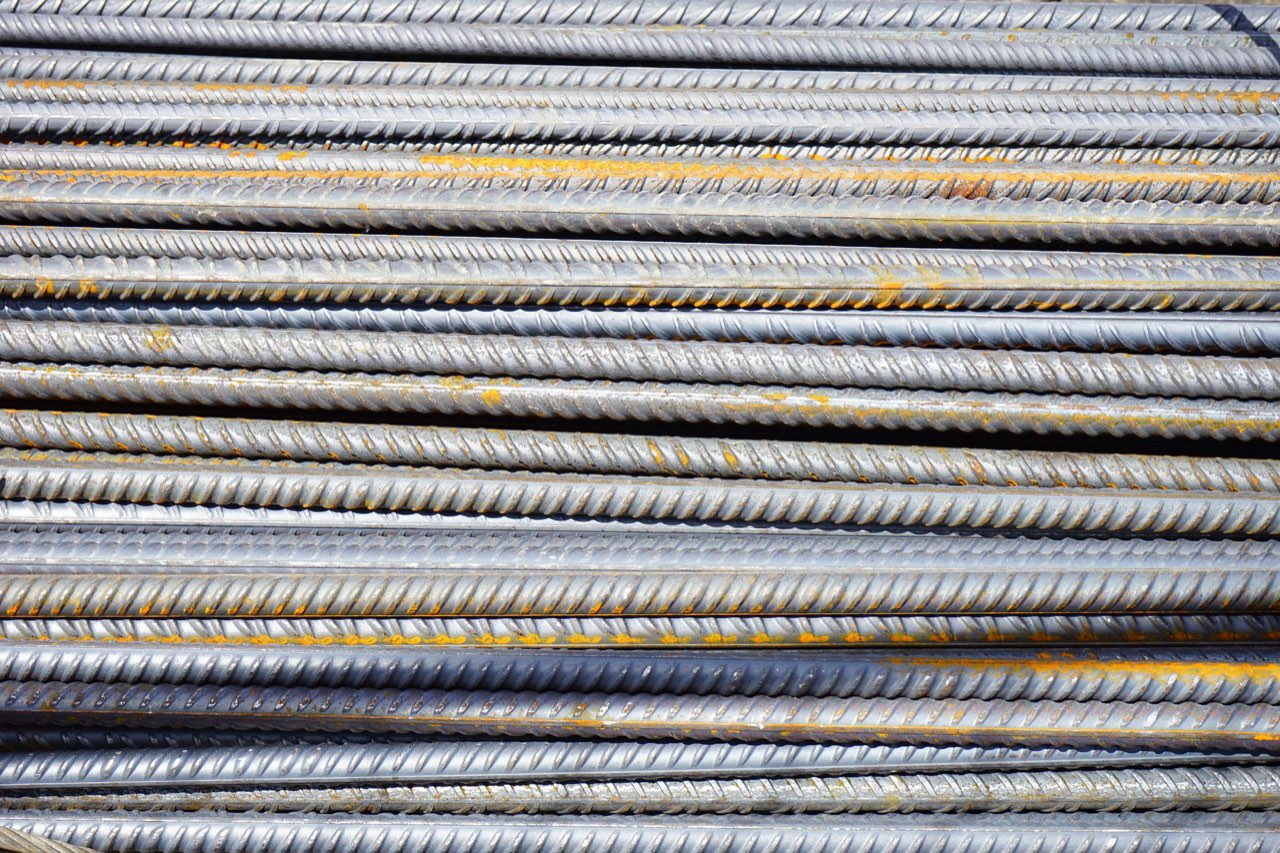
Photograph every line that does not conform, and every line whose evidence will be buried once the work moves on. Rebar, embeds, waterproofing laps, insulation and anything else about to disappear under concrete or board gets a photo whether it passed or not, because once it is covered nobody can retake it.
Nonconformances get their own number
A failed line does not get fixed inside the inspection report. It gets a nonconformance or rework number of its own, recorded on the line, and the report's result says what is held.
That keeps two records clean. The inspection report says what was found on the day and never changes. The nonconformance tracks the fix through to closure. When the item is reworked, it is reinspected on a new report that references both the original report number and the nonconformance number.
Do not edit an old report to mark an item as fixed. A report that changes after the fact stops being evidence of what was there.
A filled example
QC-0147. Riverside Clinic, project 2614. Slab on grade reinforcement, Level 1, Pour 3, gridlines B to D, 2 to 5. Hold point release before concrete placement. Drawings S-101 rev D, S-201 rev C. Spec 03 20 00, 03 30 00, 07 26 00. Inspector: J. Alvarez, QC manager. Present: M. Okafor, concrete foreman. October 6, 2026, 07:10 to 07:55.
| # | Item | Criterion | Observed | Result | Photo |
|---|---|---|---|---|---|
| 1 | Vapor retarder | 15 mil, laps 6 in. taped, per 07 26 00 | 15 mil, laps taped, one lap at C/4 about 2 in. | Does not conform, NCR-031 | 1, 2 |
| 2 | Bottom mat | #5 at 12 in. each way, per S-201 rev C | #5, spacing 11 to 13 in. | Conforms | 3 |
| 3 | Chairs | 3 in. chairs at 4 ft max | 3 in. chairs, max gap measured 4 ft | Conforms | 4 |
| 4 | Thickened edge at grid 5 | 16 in. deep, 2 #5 continuous | 16 in. deep, 2 #5 continuous | Conforms | 5 |
| 5 | Floor drain embeds | 3 per S-101 rev D, set to elevation | 3 set, elevations checked to level | Conforms | 6 |
| 6 | Construction joint at grid D | Dowels #4 at 24 in., greased side marked | Area not cleared of formwork today | Not checked |
Result: rejected pending NCR-031 and item 6. Pour held. Reinspection of the C/4 lap and the grid D joint to follow on a new report.
Anyone reading it can see what was checked, against what, and why the pour did not go ahead, without having to ask.
File it where the work lives
Sort finished reports by location and activity, not only by date. When someone asks about the C/4 lap in a year, they will know the gridline long before they know the date.
Send the report the same day to whoever needs to release the hold: the superintendent, the engineer, the owner's rep. If a hold point is released by phone and no report follows, nobody can later show when or by whom it was released.
Where Sitewise fits, and where it does not
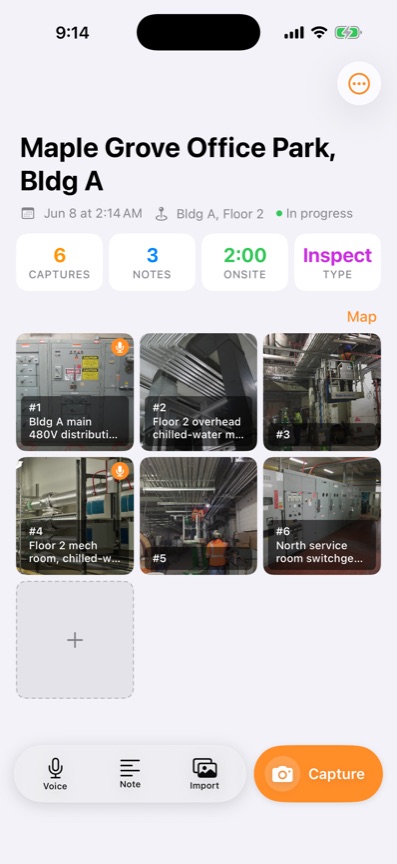
Sitewise captures the inspection on iPhone and iPad. Each photo, dictated note, sketch and typed observation carries the capture time and, with location on, a GPS pin. Voice notes transcribe on the phone, which helps when you are holding a tape across a rebar mat. On a Pro iPhone or iPad with LiDAR you can measure a dimension straight in the camera and it prints on the photo. It works in a basement with no signal and syncs later. The project exports as a PDF or DOCX, so the report can go out before you leave the slab.
It is not a QC management system. It does not track nonconformances to closure, run inspection schedules, hold drawing sets, or collect signatures, and it does not run on Android or the web. A team with a QC platform keeps it and can use Sitewise for the walk and the photos.
For the general shape of an inspection report outside construction QC, see the field inspection report template. For writing up a single failed item so the trade can fix it, use the defect report template.
Questions people ask
- What is a quality control inspection report in construction?
- It is the record that a specific piece of work was checked against its drawings and specification before it was covered up or accepted. It names the work, the documents it was checked against, each item checked, the result, and who checked it and when.
- Who writes the QC inspection report?
- Usually the contractor's quality control manager or the foreman responsible for the work, sometimes with the engineer or owner's inspector present. Whoever signs it should be the person who actually looked, because the report is only as good as that person's walk.
- What happens when an item fails the inspection?
- The item is recorded as nonconforming, with the photo and what was observed, and a nonconformance report or rework item is raised with its own number. The work stays held until the item is fixed and reinspected, and the reinspection goes on a new report that references the first one.
- How long should a QC inspection report be?
- As long as the checklist for that activity and no longer. A pre-pour check on one slab might be a dozen lines and six photos. Splitting one report per inspection keeps each one short enough to read in a minute.
Related guides
- Field inspection report template
A field inspection report template that holds up when a result is challenged: the header fields, criterion and observed value per finding, and a filled example.
- Defect report template
A defect report template built to survive a disagreement: one defect per entry, what the work fails against, a location you can walk to, and an example.
Write this report on site, not in the truck.
Sitewise turns photos, voice notes, sketches, and typed observations into a PDF or DOCX before you leave. iPhone and iPad, iOS 26 or later.
Get the app