
Field inspection report template
Updated September 3, 2026
Fill this in on your iPhone, on site, with Sitewise.
Get the appA field inspection report answers one question per item, pass or fail, and exists so that the answer holds up when somebody disagrees with it six months later. The template below is built backwards from that argument.
Inspection templates fail for the same reason: they record what the inspector saw without recording what the inspector measured it against. A finding with no criterion is an opinion, and opinions lose.
Name the standard in the header, or the results mean nothing
| Field | What goes in it | Example |
|---|---|---|
| Inspection date and time | Date, plus arrival and departure | September 3, 2026, 08:10 to 11:05 |
| Asset or area | The tag, unit number or area, as the owner's records name it | Pump Station 3, Kestrel Ridge Water Treatment |
| Inspection type | Routine, quarterly, pre-commissioning, follow-up, incident | Quarterly mechanical |
| Inspected against | The document and its revision or date | O&M manual rev C, spec section 43 21 00 |
| Inspector | Name, firm, and certification if the scope requires one | A. Nakamura, Meridian Field Services |
| Result | Pass, fail with items, or partial with items not accessible | Partial, 2 fail, 1 not accessible |
The revision is the field people skip. "Inspected against the O&M manual" is worthless when the manual has been revised twice since installation. Write the revision letter or the date.
Put the overall result at the top, not the bottom. The person opening the report already knows whether they want a pass, and burying it under two pages of preamble reads as evasion even when it is not.
Every finding carries a criterion, an observed value and a verdict
| Column | What goes in it |
|---|---|
| # | Sequential, capture order, permanent |
| Item | The component or check, named as the standard names it |
| Criterion | What the document requires, quoted or paraphrased with its reference |
| Observed | What you measured or saw, in units |
| Verdict | Pass, fail, or not accessible |
| Action | Correction required, and who owns it |
Three columns do the work: criterion, observed, verdict. Keep them adjacent so a reader can check your arithmetic without hunting.
"Coupling guard missing" is an observation. "Coupling guard required per O&M rev C section 4.2; guard absent at the drive end of P-3B; fail" is a finding, and it is one the contractor can correct without calling you to ask what you meant.
Where a criterion is a range, write the range. Where it is a judgement, say whose. An inspector who writes "acceptable in my opinion, no measurement available" is being honest, and honest beats a fabricated number every time.
Mark the photo on site, not from memory that evening
A photo of a pump skid shows a pump skid. A photo with an arrow on the weeping seal shows the finding.
Draw the mark while you are still standing at the equipment. The frame you thought was obvious at the time is rarely obvious on a laptop, and a circle drawn in the wrong place is worse than no circle.
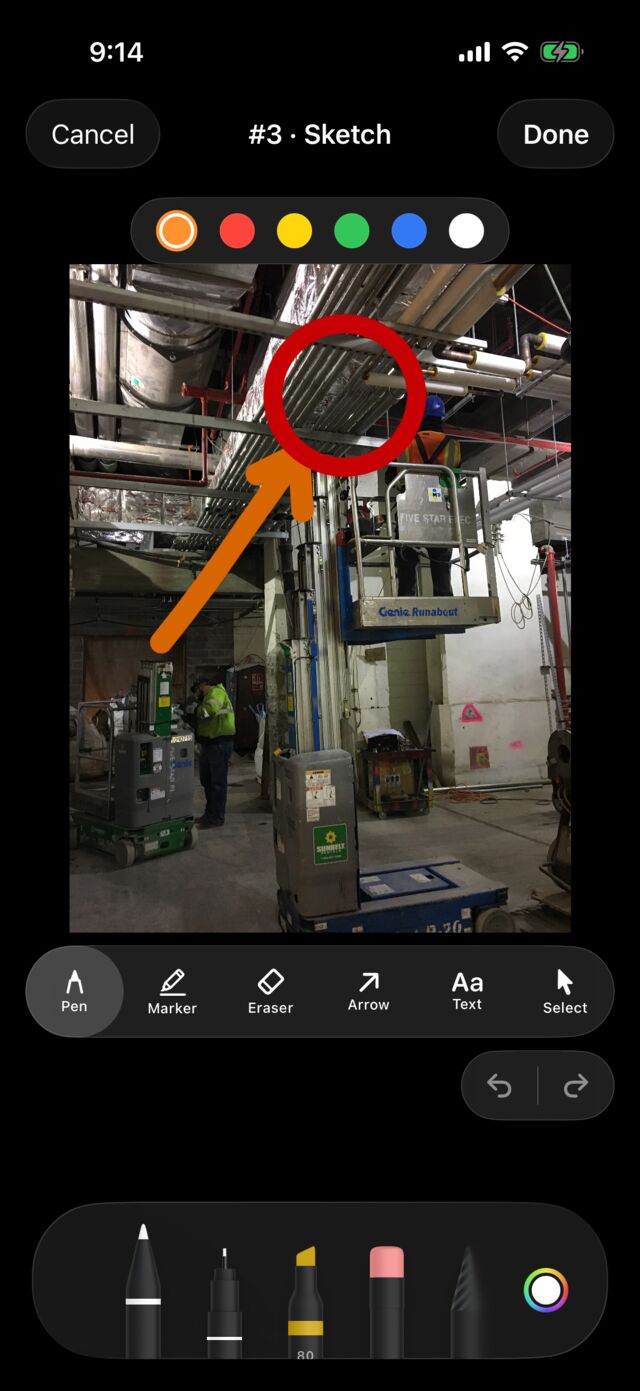
One wide shot per asset, then the close-ups. The wide shot is what lets a reader who has never been to the site work out where in the building your close-up was taken.
A filled example, from a pump station that does not exist
Inspection: quarterly mechanical, Pump Station 3, Kestrel Ridge Water Treatment Date: September 3, 2026, 08:10 to 11:05 Inspected against: O&M manual rev C, spec section 43 21 00 Inspector: A. Nakamura, Meridian Field Services Result: partial. 4 pass, 2 fail, 1 not accessible.
| # | Item | Criterion | Observed | Verdict |
|---|---|---|---|---|
| 1 | P-3A mechanical seal | No visible leakage in normal operation | Dry at the gland. Housing clean. | Pass |
| 2 | P-3B coupling guard | Guard fitted over the coupling, O&M rev C section 4.2 | Guard absent at the drive end. Fasteners in place, guard not on site. | Fail |
| 3 | Suction gauge, P-3B | Calibration current within 12 months | Calibration sticker reads March 2025. 18 months elapsed. | Fail |
| 4 | Discharge check valve, header | Free movement, no seat chatter at rated flow | Operated clean at 08:40 during the duty change. | Pass |
| 5 | Wet well level transmitter | Reading within 2 inches of the staff gauge | Transmitter 41.5 inches, staff gauge 40.0. Within tolerance. | Pass |
| 6 | Station sump pump | Runs on float, discharges clear | Sump cover bolted and sealed. Operator would not open it during the run. | Not accessible |
| 7 | Bearing temperatures, P-3A | Within the range printed in O&M rev C table 6 | 118 F drive end, 112 F non-drive, after 40 minutes running. | Pass |
Actions: items 2 and 3 to the mechanical contractor, correction and re-inspection before the next quarterly. Item 6 to the plant operator to schedule during the next station shutdown.
Seven items, two failures, one that could not be reached. Written this way, the failures are already assigned before anyone opens the attachment.
Not accessible is a result, not a gap
Reports go out with items simply missing. Six months on, nobody can tell whether they passed, failed, or were never looked at.
Give it a status of its own. Record what blocked you, when, and who was told. A row that says "cover bolted and sealed, operator declined to open during the run, 09:20, plant supervisor notified" protects everyone including the operator.
The same applies to work that was covered before you arrived. Note that it was covered, note when, and say what would be needed to verify it.
A two hundred item checklist does not need two hundred rows
A pass row for every check that passed, when the checklist runs to two hundred items. Summarize the passes by section and write full rows for anything that failed or could not be reached.
Recommendations that go beyond the scope you were engaged for. Note them separately, under a heading that says so, so a reader can tell the difference between a code failure and your professional advice.
Boilerplate disclaimers ahead of the findings. They belong at the end, and the reader is going to skip them either way.
Sitewise is the field half of this, on iPhone and iPad: photograph the item, dictate the finding while you are looking at it (the note transcribes on the phone), sketch on the photo to mark exactly what failed, type the criterion and observed value, and every capture is stamped with time and, when location is on, a GPS pin. Pump stations and vaults have no signal, so capture works offline and syncs later. The visit exports as a PDF or DOCX. It does not run checklists, hold your specification library, or collect signatures.
If you are choosing between the tools that do this on a phone, the site inspection apps roundup names the competitors and what each one is better at.
Reports get challenged at the criterion, not the observation. Nobody argues that the sticker said March 2025. They argue about whether twelve months was the requirement, which is why that column is worth more than the photo beside it.
Questions people ask
- What is a field inspection report?
- A record of an inspection carried out where the asset is, rather than in a shop or a lab. It states what was inspected, which document it was inspected against, what was observed, and whether each item passes. Equipment inspections, utility and pipeline work, structural observation, safety walks and quality control checks all produce one.
- What is the difference between a field inspection report and a site visit report?
- The standard. A field inspection report measures against something named, a specification section, a manufacturer's manual, an approved submittal, and each finding ends in pass or fail. A site visit report describes what an observer saw on a visit and ends in recommendations. The same walk can produce both, and the inspection report is the one that gets challenged.
- How do you document an item you could not inspect?
- As its own status, never as a pass. Record what blocked access, the date and time you tried, and who was told. Energised equipment, a locked vault, a covered pipe run, a unit that a tenant would not open: each is a real result, and the item stays open until someone reschedules it.
Related guides
- Site visit report template
A site visit report template with the header fields, numbered observations and caption pattern that hold up in a dispute, plus a filled example and sample PDF.
- The best site inspection apps for iPhone, checked in September 2026
Eight iPhone apps for site inspections and field reports, with what each one captures, what it exports and what it costs, checked against their own listings.
Write this report on site, not in the truck.
Sitewise turns photos, voice notes, sketches, and typed observations into a PDF or DOCX before you leave. iPhone and iPad, iOS 26 or later.
Get the app