
Property condition report template
Updated September 3, 2026

Fill this in on your iPhone, on site, with Sitewise.
Get the appA move-out inspection is won or lost at move-in. Whatever the report says on the day the keys change hands is the baseline every later claim gets measured against, and a thin move-in report cannot be repaired eleven months later.
The template below is written for a residential tenancy, where the same document gets filled twice by two different people and the two versions sit side by side. It also works for a sale walkthrough or a lender's inspection, though a commercial property condition assessment of building systems and remaining useful life is a bigger job with its own scope.
Same rooms, same order, both times
Fix the room order at move-in and never change it. Entry, kitchen, living, hall, bath, bedroom 1, bedroom 2, exterior, then meters and keys. The move-out walk repeats that order exactly, so anyone comparing the two reads down two columns instead of hunting.
| Field | What goes in it | Example |
|---|---|---|
| Property | Unit and building, as the lease names it | Unit 4B, Larkspur Court |
| Inspection type | Move-in, move-out, mid-term, or periodic | Move-out |
| Date and time | The walk itself, with start and end | September 3, 2026, 10:00 to 10:50 |
| Inspected by | Name and role | K. Osei, property manager |
| Tenant present | Yes or no, and who attended | Yes, both leaseholders |
| Compared against | The move-in report and its date | Move-in report, August 12, 2025 |
The last line matters more than it looks. A move-out report that does not name the baseline it was compared against invites the reply that no baseline existed.
Four columns per room, one photo number
| Column | What goes in it |
|---|---|
| Element | Walls, ceiling, floor, window, door, fixture, appliance. One row each |
| Condition | A word from the agreed scale below |
| Notes | Where on the element, how big, and what kind of mark |
| Photo | The capture number that shows it |
Rows for elements in good condition are worth writing. "Bedroom 2 walls, good, no marks, photo 18" at move-in is the row that decides the argument about the hole behind the door at move-out.
Notes carry the size. "Scuff on the wall" describes a mark you could cover with a thumb and a mark two feet across equally well. "Two scuffs, each about 2 inches, left of the light switch at shoulder height" describes one of them.
The condition scale has to mean the same thing to both sides
| Word | What it means |
|---|---|
| New | Unused. Fresh paint, new flooring, appliance still with its film on |
| Good | Used and sound. Nothing you would fix between tenancies |
| Fair | Visible wear consistent with normal use. Traffic paths, minor scuffs, small chips |
| Poor | Worn beyond normal use, or needs work before the next tenancy |
| Damaged | An event, not wear. Burn, tear, hole, break, missing part |
Print the definitions on the form itself, above the first room. A scale everyone signed and nobody defined is what turns a deposit conversation into a dispute.
Keep verdicts out of the notes. Write "burn mark, about 1 inch, on the worktop right of the hob" and let the photo and the date do their work. "Tenant damage, deduct" is a conclusion, and conclusions in the observation column read as a decision made before the walk.
Photograph the things nobody photographs
Wide shot of each room from the doorway, then the specifics. The ones that get missed and then get argued about:
- Meter readings, with the serial number legible in the same frame
- Keys, fobs and remotes laid out and counted
- Appliance model and serial plates
- The wall behind every door, where handles land
- Under the sinks, including the cabinet floor
- Inside the oven and the fridge seals
- Floor at door thresholds, where wear starts
- Smoke and carbon monoxide alarms, with a note that each was tested
- The exterior, including any garden or balcony surface
Timestamps and location data on each frame are what make the set hard to challenge later. A photo with an argued date is worth much less than a photo with a stamped one.
A filled example, from a tenancy that never ran
Property: Unit 4B, Larkspur Court. Move-out inspection, September 3, 2026, 10:00 to 10:50. Inspected by K. Osei, property manager. Both leaseholders present. Compared against the move-in report of August 12, 2025.
| Room | Element | Condition | Notes | Photo |
|---|---|---|---|---|
| Kitchen | Worktop | Damaged | Burn mark about 1 inch, right of the hob. Recorded as good at move-in. | 7 |
| Kitchen | Oven | Fair | Cleaned. Light staining on the door glass, not removable. | 9 |
| Living | Carpet | Fair | Traffic path from the door to the window, consistent with 13 months of use. | 12 |
| Living | Wall, south | Good | Two picture hooks removed, holes filled but not painted. | 14 |
| Bedroom 2 | Door | Damaged | Handle-shaped hole in the plaster behind the door, about 2 inches. Wall recorded as good at move-in, photo 18 of that report. | 21 |
| Bath | Sealant at bath | Poor | Mold along the tub-to-tile joint, full length. Recorded as good at move-in. | 24 |
| Whole unit | Smoke alarms | Good | Both tested and sounding at 10:35. | 27 |
| Meters | Electric | Recorded | Reading 41,882 at 10:44. Serial visible in the frame. | 29 |
| Keys | Set | Returned | 2 door keys, 1 mail key, 1 fob. Counted with the tenant. | 30 |
The carpet row is the one worth studying. Naming the tenancy length in the note is what turns "worn carpet" into a defensible position on normal wear, and it takes a few extra words.
A condition report records condition, not cost
Cost estimates. Quotes and deductions belong in a separate document, produced after someone has priced the work, and mixing them makes the report look like a bill.
Blanket entries. "All rooms: good" saves you five minutes at move-in and costs you the entire deposit conversation later.
Anything you did not personally look at. If a room was locked or full of boxes, say so, with the reason and the time.
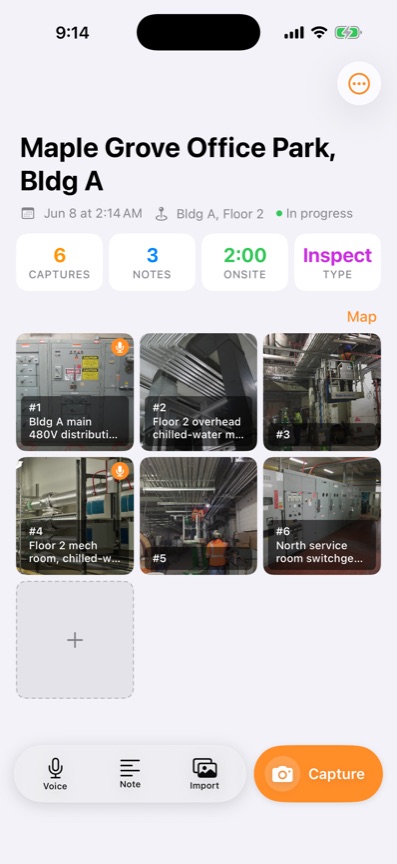
Sitewise handles the walk on iPhone and iPad: photo, a dictated note that transcribes on the phone, a sketch on the image to circle the mark, a typed observation, and each capture stamped with the time and, when location is on, a GPS pin. Basements and empty units with no signal are fine because capture works offline. The walk exports as a PDF or DOCX you can send while you are still in the car. Signatures happen outside it, on paper or in whatever platform holds your leases, because it does not do e-signature, and it does not price work or manage tenancies.
The rules for what to shoot, and when, carry over from construction: the photo documentation guide covers the ones worth borrowing.
Compare the two reports before you send anything to the tenant. The row that usually collapses a deduction is a move-in row that says "fair" where the manager later remembered "good", and finding it yourself is a much better afternoon than having it found for you.
Questions people ask
- What is a property condition report?
- A dated, room-by-room record of the state of a property, with photos, made at a moment that matters: the start of a tenancy, the end of one, a sale, or a lender's due diligence. In residential letting it is the document a deposit deduction is argued from. In commercial real estate the same phrase usually means a property condition assessment of a building's systems and their remaining life.
- What is the difference between wear and tear and damage?
- Wear is what happens to a property when someone lives in it normally: traffic paths in carpet, small scuffs at light switches, a faded blind on a sunny window. Damage is an event: a burn, a tear, a hole, a missing part. The line moves with how long the tenancy ran and with local rules, which is why the report records observations and photos rather than verdicts.
- Does the tenant have to be present at the inspection?
- They do not have to be, but a report signed by both sides at move-in settles far more than one produced by the landlord alone. Where a tenant cannot attend, send the completed report with its photos the same day and give them a stated window to add comments, then keep the reply with the report.
Related guides
- Field inspection report template
A field inspection report template that holds up when a result is challenged: the header fields, criterion and observed value per finding, and a filled example.
- Construction photo documentation that still makes sense in three years
How contractors shoot, caption and file job site photos so they hold up later: wide-medium-tight, pre-cover shots, scale objects and same-day captions.
Write this report on site, not in the truck.
Sitewise turns photos, voice notes, sketches, and typed observations into a PDF or DOCX before you leave. iPhone and iPad, iOS 26 or later.
Get the app