
How to document construction defects so the record holds up
Updated October 29, 2026
Fill this in on your iPhone, on site, with Sitewise.
Get the appTo document a construction defect, capture the photo, the description, the location and the date together, on site, in one step. Every defect record that falls apart later falls apart at the same place: a photo taken at 10:14, a note written at 9pm, and a guess about which one goes with which.
The record breaks where you join it up later
Most people document defects in two passes. They walk the building and shoot everything, then sit down that evening with forty photos in the camera roll and a page of scribbled notes, and match them up.
That second pass is where the errors come in. Two hairline cracks in two similar corridors look identical on a laptop. A note that says "bathroom 3, tile" could belong to any of the six tile photos. The room number you were sure of on site turns out to be the room next door.
Nobody notices on the day. Someone notices in month nine, when the contractor points out that the photo attached to defect #12 shows a different ceiling.
Capture each defect as a single entry while you are standing in front of it, and there is no second pass to get wrong.
Shoot three frames: where, what, and how big
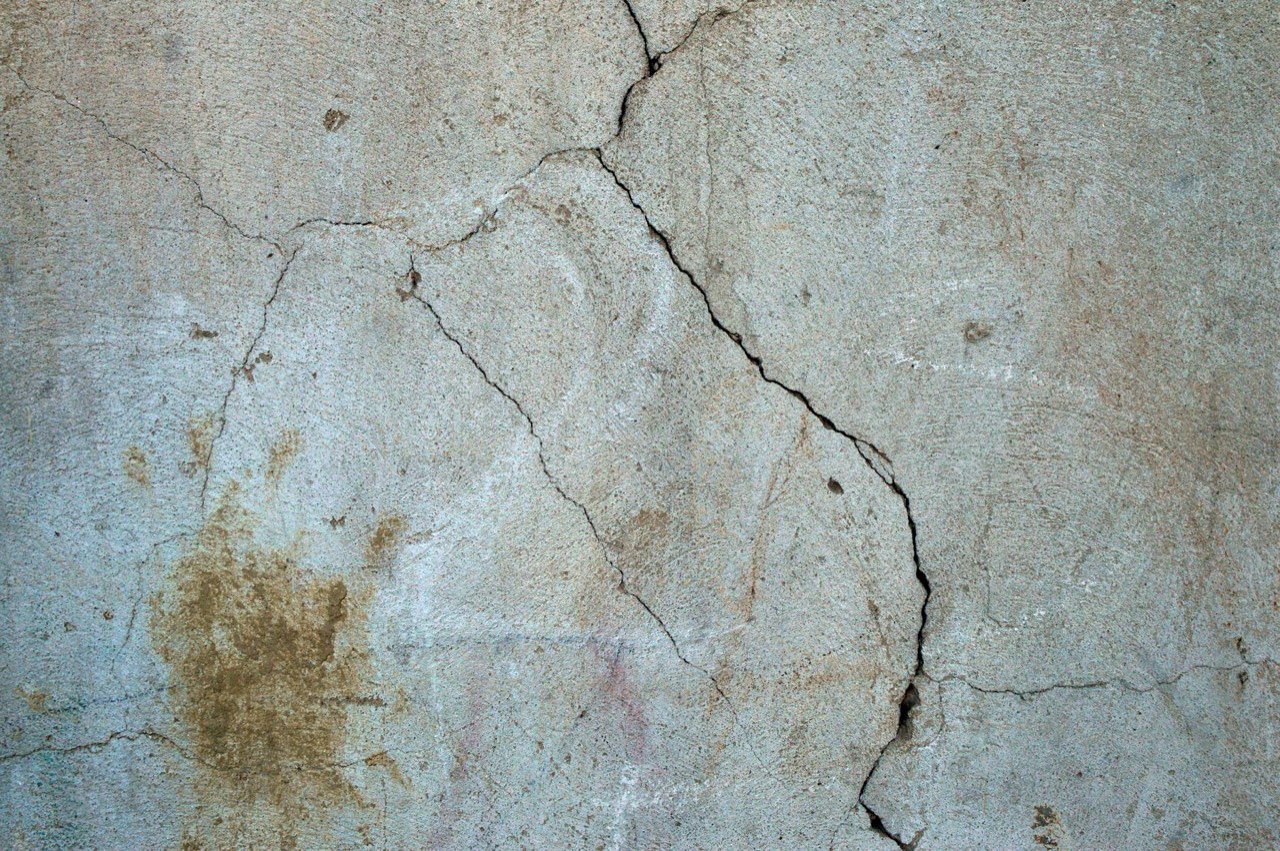
One close photo of a crack proves there is a crack. It does not prove where the crack is, and it does not say whether it is a hair or a finger wide.
Take three:
- A wide frame from the doorway or the nearest gridline, so a stranger could walk to the spot.
- A close frame that fills the picture with the defect itself.
- A frame with a tape measure, a ruler or a known object beside it, so the size is not a matter of opinion.
Shoot them in that order every time. The wide frame is the one people skip, and a fixed order makes it a habit.
For anything that will be covered up, such as a membrane lap, a fixing behind plasterboard or a pipe before the ceiling closes, add one more frame showing the surrounding work. Once it is covered, that photo is the only view anyone will get.
Write it down in measurements, in the same minute
The description goes on the photo while you are still looking at the defect, instead of on a separate sheet you fill in later.
A description that holds up has four parts:
| Part | Weak | Strong |
|---|---|---|
| Location | Upstairs bathroom | Bathroom 2.04, wall behind the basin, 300 mm above the vanity top |
| What is there | Tiling | 100 x 300 ceramic wall tile, white, laid in stretcher bond |
| What is wrong | Cracked tiles | Three tiles cracked through along one line, 410 mm long in total; two sound hollow when tapped |
| What it fails against | Poor workmanship | Tiling spec section 09 30 00 requires full adhesive bed; hollow tiles suggest it was not achieved |
The last row is the one that makes it a defect rather than a complaint. Name the drawing, the specification clause or the manufacturer's instruction the work does not meet. If you do not know which one applies, write that it needs checking, and leave the space.
Dictating is faster than typing for most of this. You can hold the tape against the wall and talk. Read the transcript before you move on, because dictation gets room numbers and product names wrong often enough to matter.
Let the device record the date and place
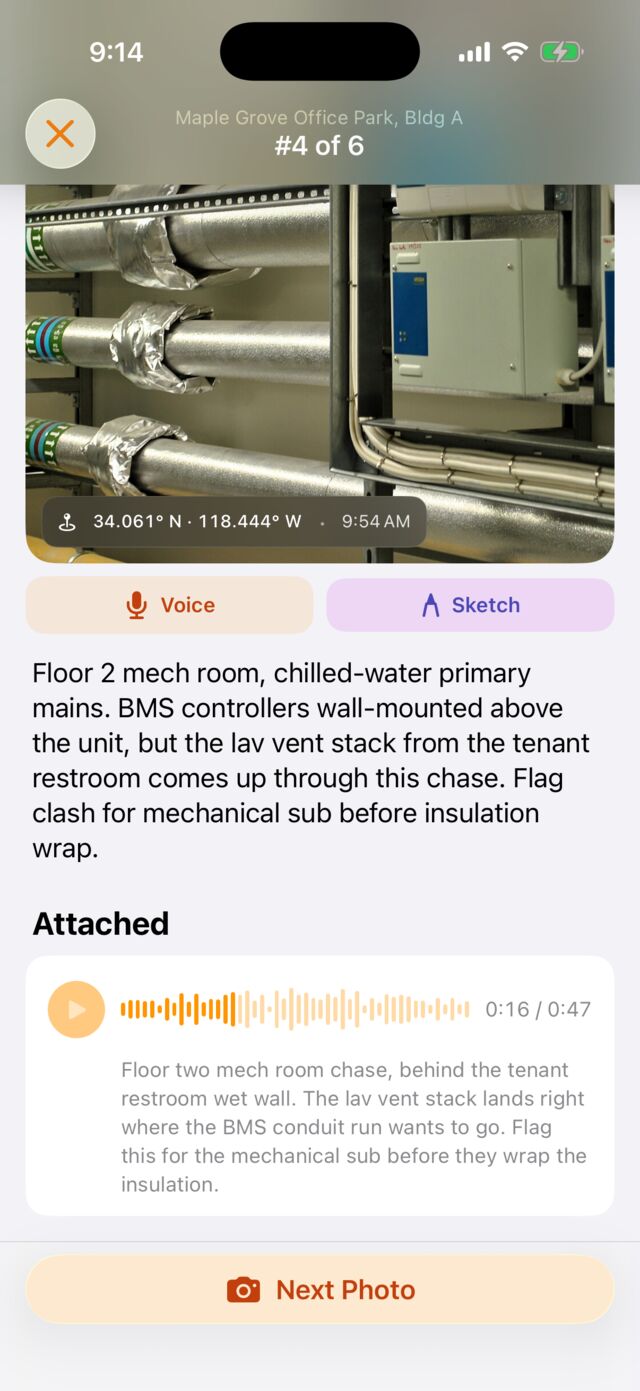
A date you type is a date someone can question. A date the phone stamped on the photo when you took it is harder to argue with, because nobody had a chance to change it.
The same goes for location. A GPS pin will not tell you which bathroom, so it does not replace the written location, but it does show the photo was taken at that address and not at another job across town.
Keep the original files. If a photo is cropped, marked up or exported, the version with the capture date and location still needs to exist somewhere. A marked-up copy is useful in the report; the original is what you fall back on when someone asks.
Mark the defect on the photo, not beside it
On a busy wall, "crack to the left of the socket" can mean three different cracks. Draw on the photo instead: a circle around the defect, an arrow to the start and end of the crack, a line where the tape reads 410.
A sketch helps for the things a photo cannot show. A floor plan with the defect marked on it, drawn roughly on the spot, places it faster than any written description, and it means a trade arriving next month does not need you there to find it.
Number each defect once and never renumber it
Give every defect a reference the moment you record it, and keep that reference forever. D-01, D-02, in the order you found them.
Sorting by severity or by trade is tempting when you write up the report, and it breaks every reference already in circulation: the email that mentions D-07, the contractor's reply about D-07, the photo filed as D-07. If you want the report grouped differently, add a column for the group. Leave the numbers alone.
When a defect comes back after a repair, it keeps its original number with a new dated entry underneath. That way a repair that failed twice shows up as one defect with two dates.
Describe what you see, not what caused it
The cause of most defects is not visible on the day. Damp on a ceiling could be the roof, a pipe, a shower tray or condensation, and you will not know until somebody opens it up.
Write what is in front of you. "Brown staining across two ceiling tiles below the level 3 riser, 600 mm across, dry to the touch at 11:20" is a fact. "Roof leak" is a theory, and if the riser turns out to be the source, the theory is the line everyone remembers.
If you have a view on what should be investigated, say so as a next step: "Recommend inspecting the riser above before any ceiling repair." That keeps the opinion separate from the record.
Send the record while the defect is still there
A defect record sent the same day reaches people who can still walk over and look. Sent a week later, it reaches people who have to take your word for it, and the conditions may have changed.
If the defect is being raised under a contract, check what notice it requires and how. Some contracts want written notice within a set time or to a named person, and a record nobody received does not count for much. That is a contract question, and your contract is the place to answer it.
Sitewise handles the capture half of this on an iPhone or iPad: each photo, voice note transcribed by Apple's speech recognition, sketch and typed note is stamped with the time and, with location on, a GPS pin, and the whole visit works with no signal and syncs later. The project exports as a PDF or DOCX with the photos and captions in order. It does not manage defects through to closure, assign them to trades, track costs or collect sign-offs, so if you need that workflow you will need a separate system for it.
For the layout of the finished document, with fields and a filled example, see the defect report template. For how to shoot and file the photos so they still make sense years later, see construction photo documentation.
Questions people ask
- What is the best way to document a construction defect?
- Photograph it, describe it and record where and when you found it in the same minute, on site, so the four pieces arrive already attached to each other. Take a wide shot that places it, a close shot that shows it, and one with something for scale. Then write what you see in measurements and name what the work fails against, if you know.
- How many photos should you take of a defect?
- At least two, usually three: a wide frame that shows where it is in the room, a close frame that shows the defect itself, and a frame with a tape or a known object for scale. More is fine while you are on site. The report only needs the ones that carry a caption.
- Should a defect record say what caused the problem?
- Only if you know, and usually you do not on the day. Record what you can see and measure, and say what would have to be opened up or tested to find the cause. A cause written down as a guess gets quoted back at you when the investigation finds something else.
- Do photo timestamps count as evidence of when a defect was found?
- They help, as long as the date was recorded by the device at capture and was not typed in afterwards. Whether a particular record is accepted is a question for the contract and the people deciding the dispute, so treat the timestamp as one part of the record alongside your notes and the date you sent the report.
Related guides
- Defect report template
A defect report template built to survive a disagreement: one defect per entry, what the work fails against, a location you can walk to, and an example.
- Construction photo documentation that still makes sense in three years
How contractors shoot, caption and file job site photos so they hold up later: wide-medium-tight, pre-cover shots, scale objects and same-day captions.
Write this report on site, not in the truck.
Sitewise turns photos, voice notes, sketches, and typed observations into a PDF or DOCX before you leave. iPhone and iPad, iOS 26 or later.
Get the app